
What the Bursting of the AI Bubble Hides: Anatomy of a Necessary Purge.
The explosion of the AI bubble will not mean the death of AI, any more than the year 2000 meant the death of the Internet
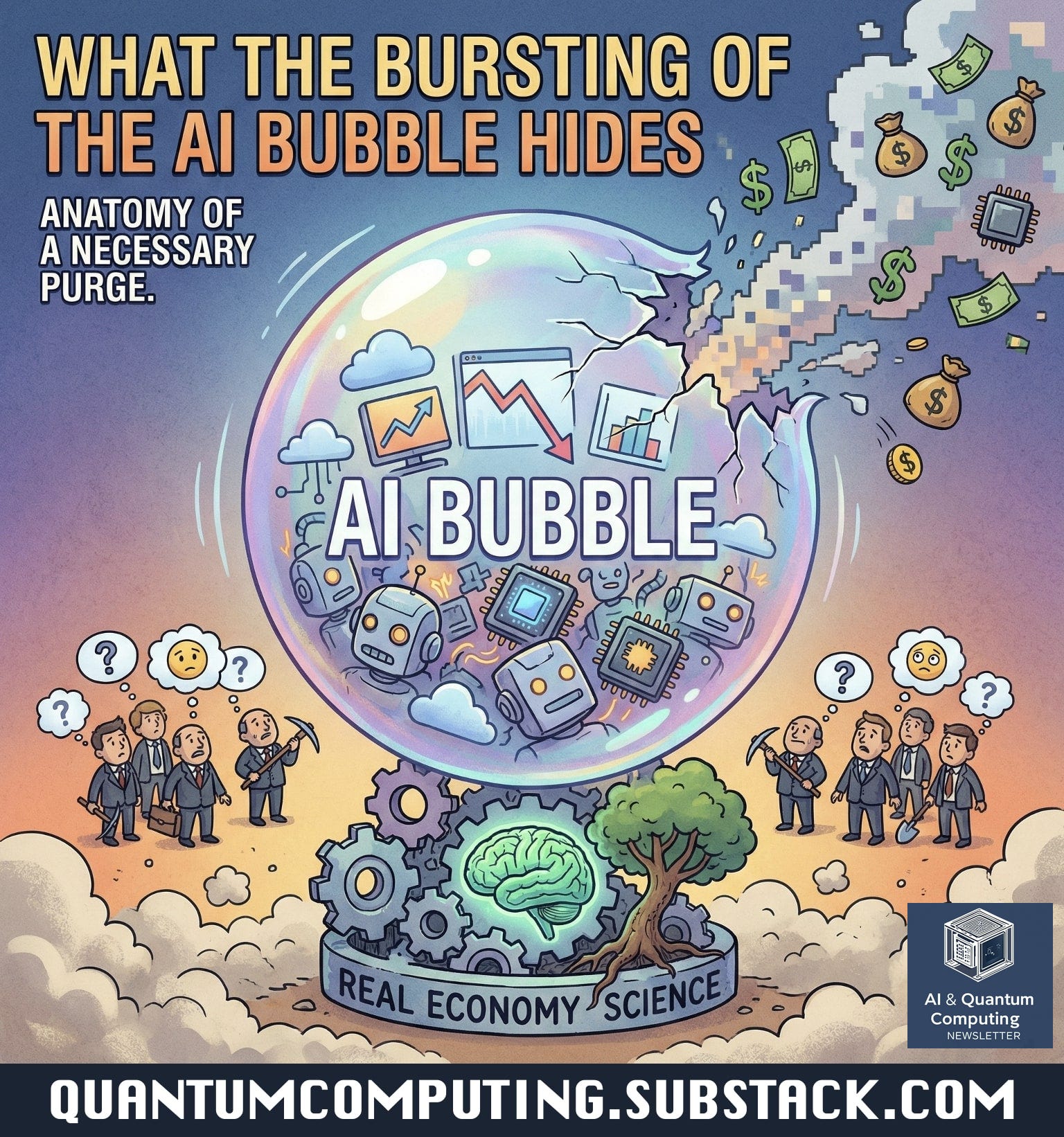
A fever has gripped markets, boardrooms, and dinner parties alike. It is a digital gold rush where graphics chips and terabytes of data have replaced shovels and pickaxes. The technology sector, accustomed to cycles of euphoria and depression, is arguably experiencing one of the most dizzying moments in its history. But the sheer magnitude of financial flows now concentrated around Generative Artificial Intelligence, coupled with the still uncertain performance of these models for the real economy, suggests a shock with multiple ripple effects.
This shock, dreaded by some and hoped for by others to cleanse the market, will have repercussions far beyond the stock charts of Wall Street. Behind the speculative frenzy lies a structural transformation of global innovation.
The explosion of the AI bubble will not be an end, but a metamorphosis.
The Missing Piece: How Bitcoin Solves the AI Economic Paradox.

We are transitioning from a Type 0 civilization (based on chemical propulsion and fiat money) to a Type I civilization (based on renewable energy, AI, and sound money).
I. History Stutters: Speculative Cycles as a Lens
Innovation often gives rise to excessive hopes. This is the very nature of technological capitalism: a promise of radical disruption that attracts impatient capital. With every breakthrough, investors bet big, companies promise revolutions, and expectations skyrocket, disconnected from immediate industrial realities. We saw this scenario with the railways in the 19th century, with the Internet at the end of the 20th century, and more recently with cryptocurrencies.
Today, it is the AI bubble that is the center of attention, with a speed and scale that are increasingly questioning analysts. When the valuations of companies like OpenAI, Anthropic, or the titan NVIDIA soar to stratospheric heights, economists instinctively dive back into market history to try to anticipate the consequences of a potential downturn.
The parallel with the year 2000 is on everyone’s lips. The bursting of the Dot-com bubble wiped out nearly half the value of the S&P 500, causing a brutal wave of layoffs in the tech sector and the disappearance of thousands of “dot-coms” that had little business model beyond their domain name. The shock was violent, traumatic for a generation of investors. Yet, and this is the crucial point, digital technologies survived.
The Internet, far from dying out with the fall of Pets.com or WorldCom, continued its underground deployment. Fiber optic infrastructures, laid at great cost during the euphoria, served as the foundation for the digital economy of the following two decades. Historian John Turner, cited in the prestigious journal Nature, recalls a fact often ignored: despite massive job cuts after the bubble burst, the volume of scientific publications in computer science never stopped growing. This resilience of the academic sector allowed research momentum to be maintained in silence while markets retracted, paving the way for the advent of Web 2.0, social networks, and cloud computing.
A similar scenario is taking shape for AI. Artificial intelligence could suffer a drastic drop in stock values without its technological base disappearing. The example of the decline in computer science degrees after 2004 illustrates this post-bubble “hangover” phenomenon, but it also highlights the lag between the rapid, hysterical movements of the markets and the deep, tectonic shifts of innovation.
II. The Gigantism of the Bubble: A Statistical Anomaly
If history serves as our guide, current figures make us dizzy. In the case of artificial intelligence, it is the disproportion that strikes. According to alarming estimates from the firm MacroStrategy, the AI bubble weighs seventeen times more today than the Dot-com bubble at its peak, and four times more than the subprime bubble that nearly swept away the global financial system in 2008.
How can such hypertrophy be explained? This frenzy has been fueled by a decade of historically low interest rates, flooding the market with liquidity desperately seeking yield. Enthusiasm around generative models (LLMs) served as the perfect catalyst. Unlike the Dot-com bubble, which involved fledgling companies without profits, the AI bubble is driven by the world’s largest companies (the “Hyperscalers” like Microsoft, Google, Amazon, Meta) which have quasi-unlimited cash reserves to finance colossal CAPEX (capital expenditures).
However, this wall of money hides a structural fragility. The current race for technological power absorbs the bulk of private funding, creating a massive crowding-out effect. All financial oxygen is sucked up by generative AI, sidelining numerous alternative research paths, accentuating a dangerous imbalance for the innovation ecosystem.
III. The Profitability Wall: The Myth of Immediate Productivity
The heart of the problem, the pin that could burst the bubble, lies in Return on Investment (ROI). The promises of AI are those of a “super-intelligence” capable of solving all problems, from computer code to drug discovery, including legal drafting.
But concrete results do not always follow the exponential curve of investments. A recent and revealing survey indicates that nearly 80% of companies that have integrated AI into their processes see no significant gain in productivity or revenue. For many, AI remains an impressive “gadget” in demonstrations, but complex, costly, and risky to integrate into critical production chains. Model “hallucinations,” data security issues, and inference costs (the cost to run the model for each query) erode margins.
System performances, while impressive, seem to be reaching a plateau, or at least, the law of diminishing returns is applying brutally. Despite increasingly heavy investments, qualitative leaps are becoming rarer. According to MarketWatch, the development of models like ChatGPT-5 would have cost the astronomical sum of 5 billion dollars, without an obvious qualitative leap compared to its predecessor. If each new generation of model costs ten times more to be only 10% better, the economic equation becomes unsustainable, even for Tech giants.
IV. The Burst as a Catalyst for Transformation
When the market realizes that AI will not replace 50% of employees next year and that revenues do not justify trillions in market capitalization, the correction will be severe. But this burst should be seen not as a catastrophe, but as a necessary shedding of skin.
A readjustment is already underway, discreet but tangible. Talent is starting to vote with its feet. Several figures in AI, coming from the laboratories of Google DeepMind, Meta AI, or OpenAI, left their comfortable positions in 2025. They are not leaving for retirement, but to found structures like Periodic Labs. This new type of entity does not seek to create a better advertising chatbot but specializes in the use of AI in the service of “hard” sciences: physics, chemistry, and biology.
This is where the real revolution lies. The current bubble has focused attention on linguistic AI (words). The bursting of the bubble will redirect attention to physical AI (the world). Other influential voices, like Yann LeCun, Turing Award winner and Chief AI Scientist at Meta, have long argued for a complete overhaul of approaches. He criticizes the purely statistical approach of current LLMs and advocates for systems capable of “understanding” the world, its physical laws, and its causalities, rather than mechanically predicting the next word in a sentence.

This shifting movement could foster a new circulation of knowledge. David Kirsch, from the University of Maryland, imagines an optimistic scenario: freed from short-term commercial logic and the pressure to release “demo” products every three months, certain elite researchers could reintegrate into the academic world. They would initiate projects with high societal impact there, far from the tyranny of stock prices.
The example of AlphaFold from Google DeepMind is the beacon of this new direction. By solving the protein folding problem, AlphaFold demonstrated how artificial intelligence can accelerate the understanding of living things, offering unheard-of perspectives for medicine. It is this type of AI, silent but transformative, that will emerge from the rubble of speculative excess.
V. A Geopolitical and Economic Redistribution
Finally, this redistribution of cards would not only concern scientific research. It will have a geographical and economic translation. Investors, scalded by the volatility of intangible technological assets, would seek to anchor their capital in the real world.
Macrostrategy experts are already recommending reallocating portfolios. The movement would happen in two stages:
A Return to the Tangible: Strengthening the share of real assets (infrastructure, energy, raw materials critical for the digital transition). AI needs energy; the bubble has highlighted the fragility of power grids. Post-bubble investment will flow massively towards carbon-free energy production to power these future digital brains.
A Pivot to Emerging Markets: Leaving the saturation of Western markets to target emerging markets like India or Vietnam. These countries, which are building their own digital and industrial infrastructure, offer growth prospects based on the actual adoption of technology, and not on the speculation of its valuation.
Final Thoughts: From Alchemy to Chemistry
The explosion of the AI bubble will not mean the death of AI, any more than the year 2000 meant the death of the Internet. It will mark the end of the age of alchemy, where one promised to transform lead (raw data) into gold (infinite profit) by magic. It will open the era of chemistry: a precise, industrial science, integrated into real processes, perhaps less spectacular, but infinitely more useful.
By cleansing the market of opportunistic actors and forcing giants to rationalize their spending, the bursting of the bubble will allow the contours of global innovation to be redrawn. Resources—human, energy, and financial—will be freed to tackle the challenges that truly matter: climate, health, and understanding the fundamental laws of our universe. The speculative party is coming to an end, but the real work is just beginning.
The Nvidia Illusion: Why the AI Giant Could Be a House of Cards on the Brink of Collapse.

In the world of finance, there is an adage: “When the music stops, things get complicated.” For two years, Nvidia has orchestrated the loudest and most lucrative symphony in Wall Street history. With a market capitalization that has defied the laws of gravity, the company led by Jensen Huang has become the absolute emblem of the Artificial Intelligence …
The Energy Standard: Why Debt is Thermodynamics, Not Economics.

By the time you finish reading this sentence, the United States national debt will have grown by nearly $100,000.
The AI Illusion: Why Andrej Karpathy Is Asking Us to Wait a Decade.

At the heart of a booming tech industry, where every new announcement promises an imminent revolution and Artificial General Intelligence (AGI) seems just a step away, a dissenting voice is making itself heard. And it’s not just any voice. It’s that of Andrej Karpathy, one of the most brilliant minds of his generation, co-founder of OpenAI, former Direc…
https://open.substack.com/pub/evolvingtheory/p/the-ai-bubble-isnt-the-dot-com-bubble-b0d?utm_source=share&utm_medium=android&r=275w0u