
The Quantum Apocalypse Won't Wait: Why Donald Trump is Accelerating the Pace In the US and How Europe is Organizing its Resistance.
Inside the aggressive new 'Project Apollo' approach transforming cybersecurity into capital warfare—and the silent European defense rewriting the rules of sovereignty.
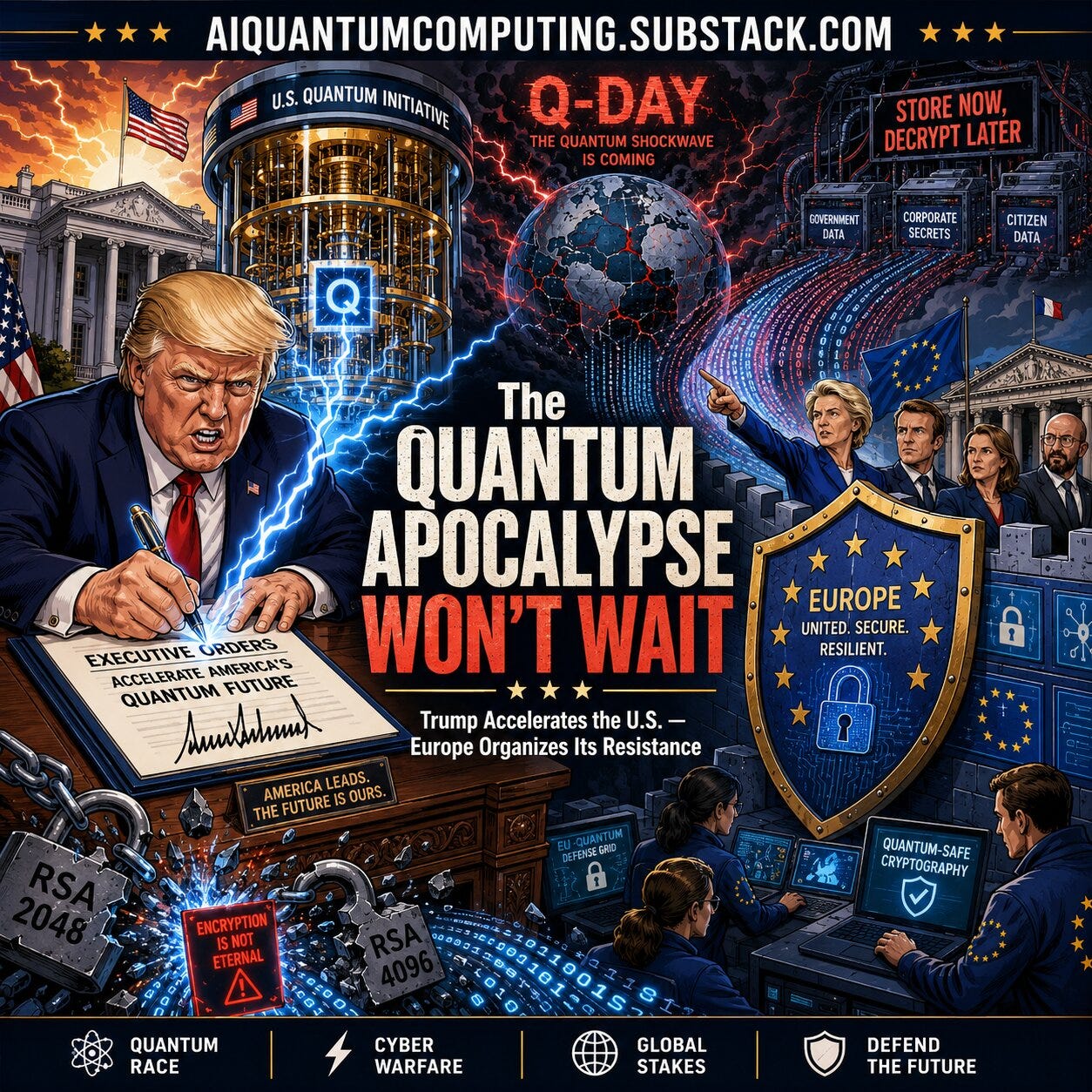
The date of Monday, June 22, 2026, will likely be etched into the history of global cybersecurity. With a simple stroke of a pen at the White House, an invisible race against time—one with planetary consequences—has just violently accelerated. Donald Trump signed two executive orders that redefine American ambition in the quantum domain. The objective? To force the advent of a “scientifically useful” quantum computer by 2028, and to mandate a drastic migration of federal encryption to unbreakable standards by 2031.
While Washington opts for an aggressive state-driven approach, Europe is silently coordinating its ecosystems, imposing strict rules through agencies like the ANSSI (French National Agency for the Security of Information Systems). But in the corporate world, a terrifying reality remains: no one truly seems prepared for this technological tsunami.
Here is why the race for quantum supremacy has become the new Manhattan Project, and why the digital survival of our institutions is playing out today, not in ten years.
The $25 Billion Paradox: Why Nvidia is Borrowing Money When It Is Printing Billions.

Unpacking the “Apple 2015 Playbook” and the strategic genius behind borrowing billions to fund an invincible corporate fortress.
Q-Day: The Threat of a Global Digital Collapse
To understand the urgency gripping the world’s major powers, one must first grasp the nature of the threat. The tech industry calls it “Q-Day”.
This is the fateful moment when a quantum computer will achieve enough processing power to break the asymmetric encryption algorithms (such as RSA or elliptic curves) that currently secure 99% of our digital lives. From your bank transactions and military communications to industrial secrets and medical records, all our digital trust rests on mathematical problems that a classical computer would take billions of years to solve. A fully realized quantum computer, using Shor’s algorithm, could crack them in a matter of hours.
Waiting for the quantum threat to become a reality before migrating our systems is like closing the vault doors when the thieves have already been inside for ten years.
While the scientific consensus traditionally estimated the arrival of this infamous Q-Day between 2033 and 2040, the geopolitical chessboard no longer allows us to rely on these reassuring forecasts. The principle of “Store Now, Decrypt Later” (SNDL) is already a reality. Hostile nation-states are intercepting and massively storing exabytes of encrypted data flowing across global networks. This data is unreadable today, but it will be decrypted as soon as the quantum machine is ready. For state secrets or intellectual property with a critical lifespan of over ten years, the hack has already happened.
The American Offensive: Two Executive Orders to Dominate the Decade
There is a fascinating constant in US technology policy: technologies deemed “experimental” or “not yet mature” always benefit from a strong presidential executive order long before they have proven their viability on an industrial scale.
Donald Trump laid the first stone of this strategy during his first term with the National Quantum Initiative Act of 2018, which doubled the federal budget allocated to quantum research. Seven years later, the two texts signed this June 22, 2026, raise the level of ambition to a quasi-military scale.
1. Building the Machine: Objective 2028
The first executive order directly targets the creation of the ultimate weapon. It mandates equipping a Department of Energy (DoE) laboratory with a quantum computer of sufficient scale to officially open “the era of quantum-assisted scientific discovery.”
The directives are clear:
An aggressive timeline: The delivery target is set for 2028. During a resounding press briefing, Michael Kratsios, director of the Office of Science and Technology Policy, brushed aside scientific skepticism by stating: “We believe this is feasible by 2028.”
A massive public-private partnership: The US government is no longer settling for subsidizing fundamental research. In May 2026, the Department of Commerce struck hard by announcing $2 billion in direct equity investments across nine key quantum companies, including a strategic joint venture with tech giant IBM.
A model of state capitalism: In exchange for this colossal funding, the federal government takes equity in these companies, thereby ensuring direct control over technological advancements and intellectual property.
2. The Cryptographic Shield: The 2031 Urgency
While the first decree is a scientific statement of intent, the second is a national security imperative with immediate effects.
It requires federal agencies to migrate all their most sensitive systems to post-quantum cryptography (PQC) standards.
Accelerated timeline: The deadline, initially set for 2035 under the Joe Biden administration, has been abruptly brought forward to 2030 or 2031, depending on data criticality.
Finalized standardization: This migration will rely on NIST (National Institute of Standards and Technology) cryptographic standards finalized in 2024, notably the ML-KEM (for key encapsulation) and ML-DSA (for digital signatures) algorithms.
Reinforced counterintelligence: The order significantly expands the mandate of American counterintelligence teams to protect the country’s quantum research labs against foreign interference, highlighting justified paranoia regarding Chinese or Russian cyber operations.
Europe: A Silent but Relentless Resistance
While the White House announcements are making headlines, it would be an illusion to believe that the Old Continent is lagging. In reality, Europe has a much stricter schedule that is already in motion, albeit deployed with its characteristic administrative sobriety.
European deadlines do not look like those of the Trump administration, and for good reason: they are driven by imperatives of sovereignty and technical certification.
The Iron Fist of the ANSSI in France
In France, the ANSSI didn’t wait for American executive orders to act. Its doctrine is one of the most avant-garde in the world:
2027 - The end of classic certifications: The ANSSI will purely and simply stop certifying cybersecurity products that lack hybrid post-quantum cryptography starting in 2027.
2030 - The purchasing ban: French public administrations and Critical Infrastructure Operators (OIVs) will no longer be allowed to purchase security solutions that are not quantum-resistant after 2030 (one year ahead of the US federal timeline).
The Illusion of Corporate Preparedness
Despite this relentless regulatory framework, the European economic fabric seems to suffer from a worrying blindness. An alarming study published in March 2025, conducted among 38 major European organizations, revealed that none of them had a quantified and operational post-quantum transition plan. Most CIOs still consider quantum computing to be a fundamental research problem, ignoring the fact that migrating their IT infrastructures (which are often aging) will take between 5 and 10 years.
The European Ecosystem: Billions and Hidden Gems
To counter this inertia, the European Union has deployed a massive strategic arsenal. The European Commission adopted its Quantum Europe strategy in July 2025, aiming to make the EU a quantum superpower by the end of the decade. The highly anticipated Quantum Act, expected by the end of 2026, will crown these efforts.
The numbers speak for themselves: over 11 billion euros in public funding have been committed over five years at the European and national levels.
Unlike the United States, which is currently betting on a federally piloted program to build “the machine,” Europe is betting on coordinating a bustling ecosystem of deeptech startups. A Franco-German alliance, sealed in May 2026, aims to structure this market, driven by globally recognized technological gems:
Alice & Bob: Pioneers of cat qubits, recognized for their revolutionary approach to quantum error correction.
C12: Specialists in quantum processors based on carbon nanotubes.
Quandela: Undisputed leaders in the field of photonic quantum computing.
The Great Clash: Two Approaches for the Same War
What separates the American and European strategies is not so much the timeline—the 2030/2031 deadlines for post-quantum cryptography are now aligned—but rather the method and the geopolitical vision.
State Capitalism vs. Industrial Coordination
Donald Trump’s executive orders cement an “Apollo Project” approach. The federal government defines the goal (a useful computer by 2028), chooses the lab, injects money massively, and takes equity to ensure a technological and security return on investment. It is a vertical, unabashed, and nationalist approach.
Europe, true to its DNA, is a breeding ground for innovation. It injects billions into university research, supports dozens of startups via the European Innovation Council, and legislates firmly (via the ANSSI or the German BSI) to create a captive market for these new technologies. It is a horizontal approach, banking on the strength of industrial coordination.
The Shadow of the Dragon: The Chinese Factor
These two Western approaches, as different as they may be, respond to the same anxiety: China’s advancement. Currently, Beijing alone concentrates roughly half of global public investment in quantum technologies. Its satellite-based quantum communication (QKD) networks, like the Micius project, are years ahead of the West. The American acceleration of June 22 is not just a scientific challenge; it is a direct response to the threat of Asian technological hegemony.
Why Companies Must Act Today
Faced with these high-flying geopolitical and technological upheavals, executive boards and Chief Information Security Officers (CISOs) of companies can no longer afford to be mere spectators. There are two fundamental reasons making inaction untenable:
1. The regulatory vice is tightening at top speed
The post-quantum migration is no longer a distant horizon or a technical parlor discussion. Certifications issued by the ANSSI for products without a quantum-resistant component will lose their value in 2027. Public procurement will become illegal in 2030. For a company providing services to the State, or for a Critical Infrastructure Operator, this means cryptographic audits of their information systems must be launched now. Software development cycles, replacing network hardware, and updating Public Key Infrastructures (PKI) take years. Waiting until 2028 to start is a guaranteed way to be outlawed in 2030.
2. US technological protectionism is intensifying
The tightening imposed by the Trump administration on protecting its research (the counterintelligence aspect of the second order) will inevitably be accompanied by severe export restrictions on American quantum and cryptographic technologies. This new “Technological Iron Curtain” will complicate European companies’ access to transatlantic solutions, making partnerships more opaque and complex. In this context of heightened sovereignty, European coordination and the adoption of local solutions are no longer just a political preference but an operational necessity for survival.
The Emergency Action Plan for Decision-Makers
To avoid taking the full brunt of Q-Day, organizations must begin their transformation through three pillars:
Inventory and Discovery: You cannot protect what you don’t know you have. The first step is to map all encryption algorithms used within the company, including those buried in third-party software or legacy hardware.
Cryptographic Agility: The immediate goal is not to replace everything with post-quantum, but to make systems “agile.” Business logic must be separated from cryptographic logic so that security algorithms can be swapped out on the fly, without having to rewrite millions of lines of code.
Hybridization: Cybersecurity agencies strongly recommend a hybrid approach. Rather than throwing away current RSA encryption, it should be layered with a post-quantum algorithm (like ML-KEM). Thus, for an attacker to break the security, they will have to simultaneously crack the classic algorithm AND the new quantum algorithm.
Final Thoughts: The Dawn of a New Era
The quantum race, which just entered its final sprint this June 22, 2026, is now playing out in two simultaneous acts, intimately linked but temporally discordant.
On one side, there is the promise of absolute power: the hope, backed by billions of dollars and Washington’s political willpower, of seeing a scientifically useful machine emerge by 2028, even if the consensus among physicists tends to push this miracle to the following decade.
On the other side, there is the absolute urgency of the digital shield: a cryptographic migration whose criticality is very real and rooted in the present. Faced with this certainty, Europe has had the immense prudence to set its own regulatory deadlines without waiting for American or Chinese laboratories to dictate the global tempo.
The message for organizations is unequivocal: the quantum computer doesn’t need to be sitting on your CIO’s desk in 2028 to destroy your company’s value. The threat is already in your networks through data interception, and the regulatory clock is already ticking. The question is no longer if the world will shift into the quantum era, but whether you will be among those who secured their foundations before the earthquake, or those who will watch their data evaporate.
Meet the "Nostradamus of AI": The 24-Year-Old Mastermind Behind a $20 Billion Empire.

The history of global finance is punctuated by periods of frenzy, pivotal eras where a new technology upends the established order, redrawing the maps of wealth and power. From the railroads to the dawn of the Internet, every industrial revolution has birthed its visionaries, its prophets, and, inevitably, its speculative bubbles.
Forget SpaceX’s Valuation: The $1 Trillion Machine That Unlocks the Quadrillion-Dollar Cosmos.

Humanity scraped a finite globe for millennia. Today, the miracle of reusable rockets is unlocking the universe’s ultimate post-scarcity economy.
The Quantum Supercomputer is Moving In.

In 1994, the Internet was in its infancy. Secure communication, the bedrock of modern digital commerce, relied on cryptographic protocols like RSA. These protocols were—and still are—predicated on a simple mathematical asymmetry: multiplying two large prime numbers together is computationally trivial, but factoring the resulting massive integer back int…