
Your Personal Olympic Coach: 3 Ways Quantum Biomechanics Fixes Your Back Pain.
Stop Guessing Why You Hurt. Start Calculating How to Heal.
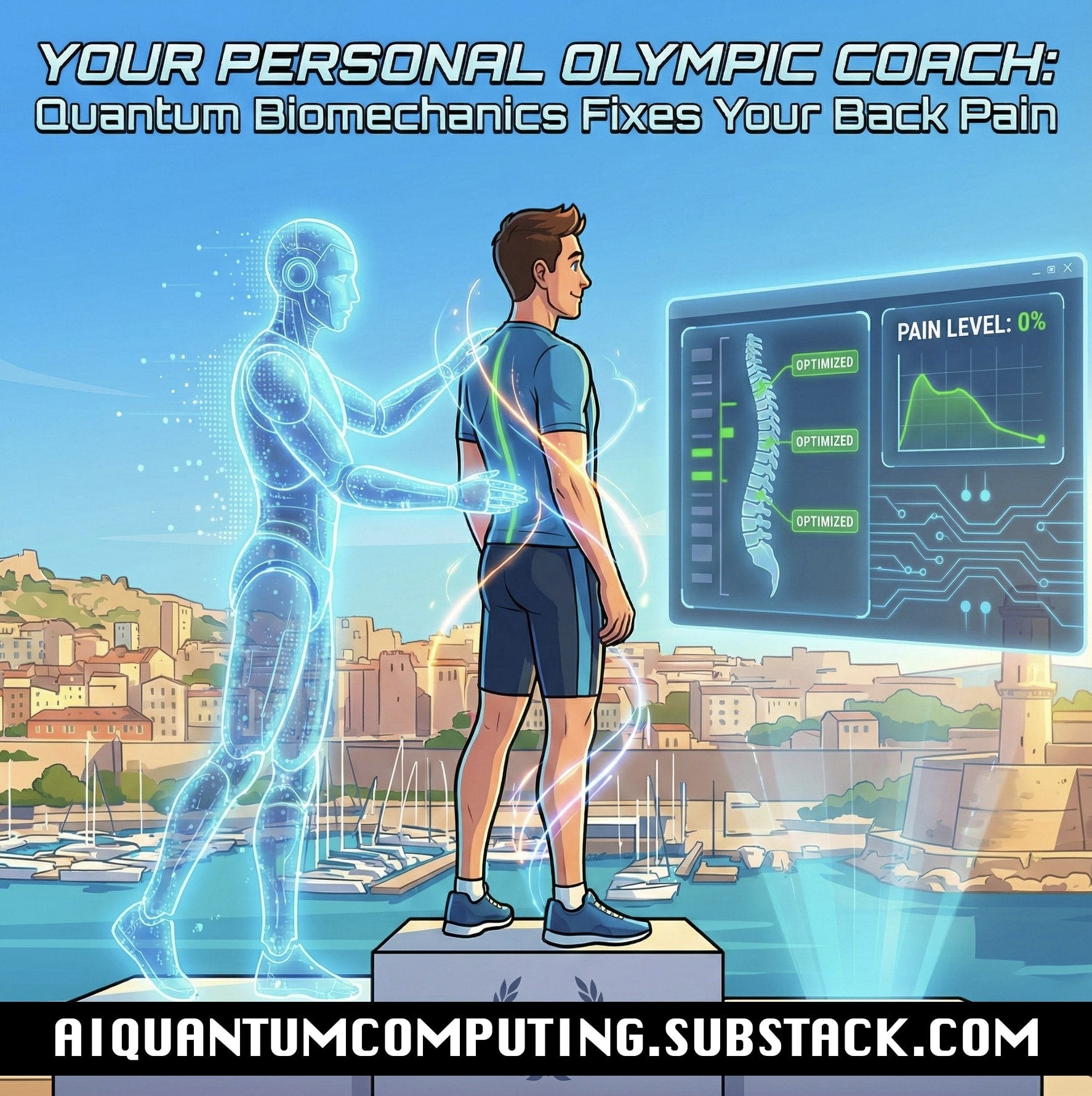
Yesterday was the final Sunday of the year here in Marseille. The festive chaos of Christmas has settled into a quiet, introspective lull. The mistral wind has scrubbed the sky a brilliant, hard blue, but it’s cold enough that the locals are huddled in their coats, walking briskly along the Corniche.
As I watched the runners jogging by the sea, I noticed the tell-tale signs. The slight grimace on the man favoring his left knee. The woman was rubbing her lower back as she paused at a traffic light. The stiff, guarded gait of an older gentleman carrying a baguette.
We are approaching New Year’s Eve, the global holiday of good intentions. Millions of people are about to vow to “get fit” or “fix that bad back.” They will join gyms, download yoga apps, and buy foam rollers. And by February, most of them will have quit, defeated not by a lack of willpower, but by pain.
Chronic pain, particularly back pain, is the silent epidemic of modern life. We sit too much, we look down at screens, and when we try to move, we often do it wrong. For decades, the solution has been crude: generic advice (”lift with your knees”), expensive physiotherapy that relies on the subjective eye of a human, or painkillers that mask the symptom without fixing the cause.
Elite athletes—the Olympians—don’t live like this. They have access to biomechanics labs where cameras track markers on their skin, and supercomputers analyze their force vectors to optimize every millimeter of their movement. It is a world of precision engineering applied to the human body.
Until now, that level of care cost millions. But the arrival of Quantum Biomechanics is about to democratize it.
By combining the computer vision of AI with the simulation capabilities of Quantum Computing, we are moving from a world of “guessing” why you hurt to “calculating” exactly how to fix it. We are entering an era where your smartphone doesn’t just track your steps; it understands the physics of your skeleton better than any surgeon.
Here are the three ways this technology will act as your personal Olympic coach, fixing your back pain not by magic, but by math.
1. The Diagnosis: Creating Your “Kinetic Digital Twin.”
The Current Problem
When you go to a doctor or physical therapist with back pain, they often look at the site of the pain. It hurts here, so the problem must be here. But the human body is a “kinetic chain”—a complex, interconnected system of levers and pulleys. Your lower back pain might actually be caused by a stiff ankle that forces your hip to rotate oddly, which torques your spine.
Detecting these subtle, domino-effect failures requires analyzing the body in motion. Classical motion capture (the kind used in movies) is expensive and requires a studio. Phone apps that claim to check your posture are simplistic; they measure static angles in 2D, failing to capture the 3D rotational forces that actually cause injury.
The Quantum AI Solution
Quantum Biomechanics allows us to create a high-fidelity “Kinetic Digital Twin” of your body using nothing but a smartphone camera.
Modeling the human body in motion is an incredibly complex physics problem. You have hundreds of muscles, tendons, and ligaments, all interacting non-linearly. To simulate this accurately in real-time requires solving massive systems of differential equations. This is where the quantum advantage kicks in.
A Quantum AI can take a simple 10-second video of you walking across your living room and use probabilistic modeling to infer the internal forces acting on your joints. It doesn’t just see the skin; it “simulates” the skeleton underneath.
How It Changes Your Life
The Root Cause Analysis: instead of saying “you have lower back inflammation,” the app will say: “Your right glute is firing 40 milliseconds late during your walking stride. This is causing your pelvis to tilt, putting 15% excess shear force on your L4 vertebra.”
The Pre-Emptive Scan: You won’t wait for pain to appear. A weekly scan will act like a “Check Engine” light for your body. The system will detect that your running gait has shifted slightly (perhaps due to worn-out shoes) and warn you before the stress fracture happens.
No More Guesswork: You stop wasting time stretching your hamstrings when the problem was actually your ankle mobility. You treat the source, not the symptom.
2. The Feedback: Real-Time “Proprioceptive Correction.”
The Current Problem
Even if you know what to do—say, a deadlift or a squat—doing it correctly is hard. We lack “proprioception,” the innate sense of where our body is in space. You think your back is straight, but it’s actually rounded. You think your knees are stable, but they are caving in.
A human coach can yell “Keep your chest up!” but they can’t see the internal forces, and they aren’t there with you at 6 AM when you’re working out in your garage.
The Quantum AI Solution
Quantum processors are fast enough to run these physics simulations with near-zero latency. This enables Real-Time Haptic Feedback.
We are seeing the emergence of smart clothing—leggings, shirts, and socks—embedded with simple sensors. The Quantum AI processes this data stream instantly to create a “predictive error model.” It anticipates that you are about to round your back before you actually do it.
How It Changes Your Life
The “Nudge” Suit: Imagine wearing a shirt that gently vibrates on your lower back the millisecond your posture breaks. It’s not a painful shock; it’s a tactile cue that trains your brain faster than any verbal instruction. It acts as an external nervous system, guiding you into the perfect groove of the movement.
The Augmented Mirror: You look at your phone or a smart mirror while exercising. Instead of just seeing a video of yourself, you see a color-coded overlay of stress. Your knees glow green (safe), but as you descend into a squat, your lower back turns amber, then red. You adjust instantly until it turns green again. You are learning to move safely by “gamifying” your own biomechanics.
Injury-Proofing Daily Life: This isn’t just for the gym. The system could run in the background via your smartwatch. After three hours of sitting hunched at your desk, it doesn’t just say “Stand up.” It detects the specific creeping tension in your trapezoids and guides you through a 30-second micro-movement to reset the muscle before it spasms.
3. The Prescription: The “Minimum Effective Dose.”
The Current Problem
Go to any gym, and you will see people doing “3 sets of 10.” Why? Because it’s a nice round number. It’s arbitrary.
Physical therapy exercises are often generic and boring. “Do 20 clamshells.” But are 20 enough to stimulate your specific weak muscle? Is it too many, causing fatigue and poor form? We treat exercise like a blunt instrument, hammering the body and hoping for adaptation.
The Quantum AI Solution
Biology is not linear. It is specific. To strengthen a specific tendon without inflaming it requires a precise amount of load, applied at a precise angle. This is the “Minimum Effective Dose.”
Quantum optimization algorithms can calculate this sweet spot for your unique physiology. By analyzing your Digital Twin, the AI can prescribe a workout that is mathematically guaranteed to provide the maximum structural benefit with the minimum wear and tear.
How It Changes Your Life
The 12-Minute Miracle: The AI might tell you, “You don’t need to run 5 miles. Based on your current joint health, you need to do these 4 specific movements for 12 minutes to stabilize your spine.” It cuts the junk volume out of your workout.
Dynamic Loading: If you slept poorly (which the AI knows from your biometric data), your connective tissue is more prone to injury. The AI automatically adjusts your workout difficulty down by 18% for that day. It pushes you when you are resilient and protects you when you are fragile.
The End of “No Pain, No Gain”: We have been taught that exercise must hurt to work. Quantum biomechanics proves the opposite. By finding the perfect mechanical leverage, exercise becomes smooth and efficient. You leave your workout feeling energized and aligned, not shattered.
The Democratization of Performance
As the sun begins to set over the Mediterranean, casting long shadows across the promenade, I think about the promise of this technology.
For a century, we have treated our bodies like mysteries. We use them until they break, and then we rely on doctors to patch them up. We accepted back pain as the “tax” of aging or the price of sitting at a desk.
Quantum Biomechanics rejects this resignation. It suggests that pain is not a destiny; it is a data error. It is simply a signal that the machine is operating outside of its optimal parameters.
By giving every person the tools that were once reserved for gold medalists—the ability to see, understand, and optimize their own physics—we are not just “fixing back pain.” We are handing people the keys to their own physical freedom. We are moving toward a future where we can age with grace, strength, and a fluidity of movement that lasts a lifetime.
So, as you make your resolutions for 2026, perhaps the goal shouldn’t just be to “exercise more.” It should be to move smarter. The coach you’ve been waiting for is almost here, and it fits in your pocket.