
NVIDIA: The Trillion-Dollar "Green Light".
How the world's most valuable company funded a 500TB pirate heist to win the AI race.

Key Takeaways
NVIDIA knowingly ignored warnings of illegality to acquire 500 TB of books.
Commercial pressure (GTC 2023) took precedence over legal ethics.
The music industry is demanding “GDP-level” damages, adding chaos to the legal landscape.
“Fair Use” is NVIDIA’s last shield, but the “Green Light” email may have shattered it.
This is a story of a white-collar heist on a planetary scale, where the loot isn’t gold or currency, but the sum of digitized human knowledge. Imagine the scene: on one side, NVIDIA, the Silicon Valley titan, a company that recently shattered the $3 trillion market cap ceiling thanks to its H100 chips. On the other, Anna’s Archive, a “shadow library” operating in the web’s gray zones, compiling millions of books without paying a single cent in royalties.
Between them? A series of leaked internal emails that reveal a brutal truth: to win the Artificial Intelligence race, the “Green Giant” didn’t just crawl the open web; it knowingly negotiated and paid for access to pirated content.
Here is the autopsy of a scandal that redefines the boundaries of technological ethics and corporate cynicism.
1. The Leak: Case No. 1:26-cv-00002
It all started with a Class Action lawsuit filed in the Federal Court of New York. Within the documents of Case No. 1:26-cv-00002, the internal communications of NVIDIA’s “Data Strategy” team were laid bare.
These aren’t just watercooler rumors; they are “smoking gun” evidence. The emails reveal a team under immense pressure, obsessed with a single objective: feeding the beast. To ensure NVIDIA’s AI models—like those unveiled at the GTC 2023 conference—could compete with the likes of OpenAI or Google, they needed text. Not just messy Reddit threads or SEO-optimized blogs, but books. Millions of them.
The 500 TB Buffet
NVIDIA wasn’t looking for small samples. They targeted the entire catalog hosted by Anna’s Archive, which aggregates the world’s most notorious piracy hubs:
Books3: A collection of 196,000 books sourced from the Bibliotik tracker.
LibGen (Library Genesis): The global gold standard for scientific and academic texts.
Sci-Hub: The “Robin Hood” of research, hosting millions of paywalled papers.
Z-Library: A massive repository of fiction and non-fiction.
In total, NVIDIA sought to ingest nearly 500 terabytes of data. To facilitate this massive transfer, the emails reveal that NVIDIA paid “high-speed access fees” amounting to tens of thousands of dollars. They weren’t just “finding” data; they were subscribing to a pirate service.
2. The Surreal Dialogue: “Do you have permission?”
Perhaps the most mind-blowing moment in this saga is the exchange between the “pirates” and the “engineers.” In a series of emails, the administrators of Anna’s Archive—hardly strangers to illegal activity—seemed almost concerned for their high-profile client.
They explicitly asked NVIDIA: “Do you have internal authorization to handle this data? You are aware that these collections are technically illegal?”
NVIDIA’s response came in less than a week. No panic, no long-winded legal consultation, no hesitation. The message was simple: “Green light.”
Strategic Analysis: This “Green Light” response is the nail in the coffin for NVIDIA’s defense. In copyright law, there is a fundamental distinction between accidental infringement and “willful infringement.” By ignoring an explicit warning, NVIDIA moved itself into the latter category, which can increase statutory damages by a factor of a hundred.
3. The GTC 2023 Pressure: The End Justifies the Means
Why the rush? The answer lies in three letters: GTC. The GPU Technology Conference in March 2023 was the moment Jensen Huang, NVIDIA’s CEO, had to prove to the world that his company wasn’t just selling “shovels” for the AI gold rush, but was also a leader in Large Language Model (LLM) development.
To train a high-performing model, one must follow specific scaling laws, often summarized by the “Chinchilla” findings. We can approximate the data needs as follows:
Where D is the number of tokens (words or fragments) and N is the number of parameters in the model. For models with hundreds of billions of parameters, the “clean” web isn’t enough. You need literature, science, and complex reasoning—the kind only found in books.
NVIDIA made a cynical calculation: the legal risk of being caught was less dangerous than the industrial risk of presenting an “unintelligent” AI at their flagship event.
4. Anna’s Archive: Public Enemy Number One
While NVIDIA scrambles to manage the PR fallout, Anna’s Archive is already fighting on a second, even more surreal front.
The heavyweights of the music industry—Spotify, Universal Music, Warner, and Sony—have filed a lawsuit seeking the astronomical sum of $13 trillion. To put that number in perspective:
It is roughly the GDP of China.
It is more than four times the total market capitalization of NVIDIA.
Why such a staggering number?
The lawsuit follows a “backup” of 300 TB of Spotify data that the archive allegedly performed and made accessible. The majors’ calculation is simple: they multiply the number of songs by the maximum statutory fine for copyright violation per work.
Judge Jed Rakoff, known for his toughness on white-collar crime, issued a global injunction on January 20, 2026. As a result, several of Anna’s Archive’s domains were seized, and the site is being hunted into the deepest corners of the web.
5. The “Fair Use” Defense: An Argument Taking on Water
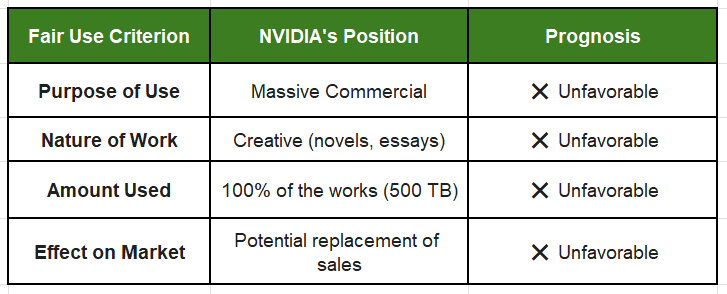
NVIDIA, much like OpenAI or Meta before it, will plead “Fair Use.” Their argument: the AI doesn’t “copy” the books; it “learns” from them to create something entirely new—a transformative work.
However, the context here is uniquely damaging:
Massive Commercial Use: NVIDIA is using this data to sell subscriptions, APIs, and servers worth millions.
Illicit Origin: Unlike a search engine bot crawling the open web, NVIDIA knowingly paid a pirate service to bypass technical protections and access “locked” data.
Market Substitution: If an AI can summarize or mimic an author’s style because it ingested their pirated book, it directly competes with the original work.
6. The Bitter Irony: Titans Fed by Pirates
There is a profound irony in seeing NVIDIA, the crown jewel of the tech industry, depending on “hackers” and shadow librarians to fuel its innovation. Without piracy, AI as we know it today would likely not exist—or would be significantly less advanced.
This raises an existential question for the digital age: Does technological progress justify cultural pillage?
If NVIDIA wins this case, it validates the idea that for the ultra-wealthy, copyright laws are merely “operating costs.” If NVIDIA loses, it could be forced to delete its models (a process known as “machine unlearning”) and pay fines that, even for a trillion-dollar company, would be devastating.
7. Final Thoughts: Toward a New Digital Compact
The NVIDIA / Anna’s Archive affair is a symptom of a broken system. We are living in a “post-truth” era of copyright, where data is extracted like crude oil, with no regard for the owner of the land.
Between the $13 trillion Spotify lawsuit and the leaked NVIDIA emails, 2026 is shaping up to be the year of the Great Reckoning between Big Tech and Intellectual Property.
For now, Anna’s Archive continues its cat-and-mouse game with justice, switching domains as easily as one changes a shirt, while NVIDIA continues to dominate the stock market. But for the first time, the curtain has been pulled back on the “AI kitchen,” and the smell coming from it is anything but appetizing.