
Andrew Yang's Warning: The Twilight of White-Collar Workers and How AI is Redrawing the Professional Landscape.
Millions of highly skilled jobs could vanish in the next 18 months as artificial intelligence automates the cognitive tasks we once thought were strictly human.
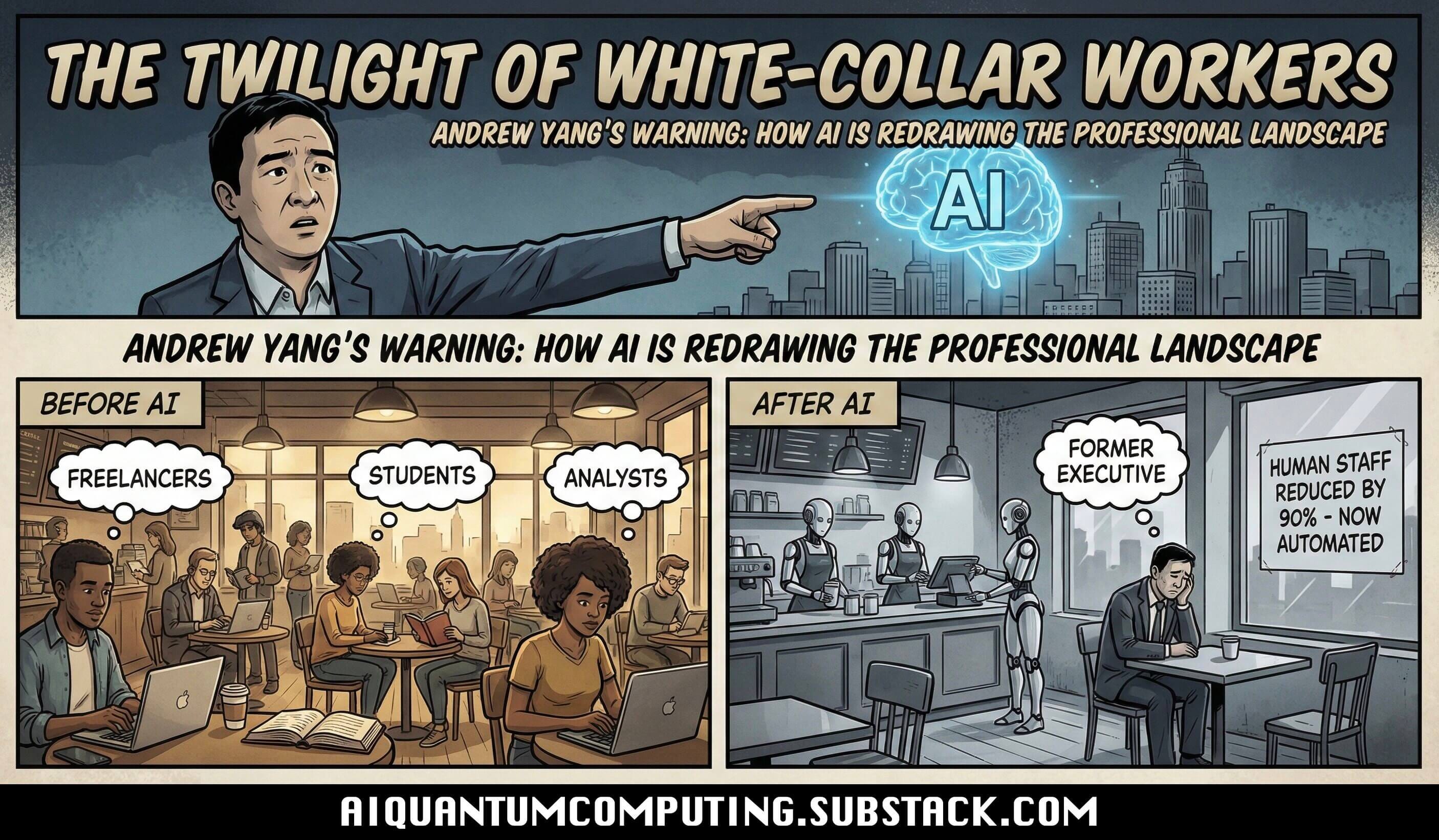
The image is striking, almost dystopian, yet it may soon become our everyday reality. Imagine your local coffee shop—your usual Starbucks—no longer filled with college students cramming for midterms or freelancers working on creative side hustles, but instead populated by former executives, marketing directors, financial analysts, and corporate lawyers. Highly qualified professionals, graduates of top-tier universities, suddenly sidelined from the labor market by an invisible and lightning-fast force: artificial intelligence.
This is the brutal warning issued by Andrew Yang. The former U.S. presidential candidate, known for his pragmatic and often avant-garde analyses of socio-economic dynamics, is sounding the alarm. According to him, we are not at the dawn of a smooth transition, but standing at the edge of a precipice. Within the next 12 to 18 months, millions of so-called “white-collar” jobs could simply vanish.
This is no longer science fiction; it is an accelerating economic reality described by Yang. Let us deeply analyze the ramifications of this impending tectonic shift.
1. The End of Cognitive Immunity: From the Factory Floor to the Office
For decades, the narrative of automation followed a predictable, well-worn path. Machines, robots, and first-generation algorithms were designed to replace manual, repetitive, and physically demanding labor. Blue-collar workers on automotive assembly lines, in logistics warehouses, and across the manufacturing sector were the first to bear the full brunt of modernization-induced layoffs.
During this time, knowledge workers—the white-collar class—believed they were safe. Their primary tools were their brains, their critical thinking, their analytical skills, and their creativity. The underlying assumption was that while machines could replace muscle, they could never replicate complex human thought.
Today, that illusion of security is shattering. As Andrew Yang points out, AI is no longer content with automating industrial processes; it is directly targeting intellectual labor. Generative artificial intelligence and advanced large language models are fundamentally redefining the equilibrium of skilled employment. Industries that once thought themselves untouchable are already recording job cuts numbering in the tens of thousands.
“A family member used AI to code a website this week,” noted Andrew Yang. “She accomplished in a few minutes what previously took days of work for a designer or a firm.”
This specific example is merely the tip of the iceberg. This spectacular efficiency comes at a heavy price: human employment itself.
2. The Decimation of Middle Managers and Analysts
Who exactly is in the crosshairs? Primarily, jobs that consist of gathering information, aggregating data, analyzing it, and producing reports. These tasks, which form the backbone of countless corporate sectors, are now perfectly digestible for AI.
Here are the professions and sectors most immediately vulnerable:
Finance and Accounting: Financial analysts spend hours scrutinizing balance sheets and market trends. AI can ingest years of global financial data and generate predictive reports in a matter of seconds.
Law: Paralegals and junior associates spend considerable time conducting case law research and drafting contract templates. These tasks are increasingly being delegated to specialized software.
Software Development: Coders, once considered the architects of the modern world, are watching AI write, debug, and optimize complex lines of code with disconcerting speed.
Marketing and Content Creation: From drafting advertising campaigns to designing graphic elements, generative AI produces professional-grade results instantly.
Human Resources and Consulting: Resume screening, preliminary candidate evaluation, and organizational analysis are becoming heavily automated.
Andrew Yang specifically targets middle management. In the modern corporate hierarchy, middle managers are often tasked with bridging the gap between strategic leadership and operational execution. They are expensive to maintain, and when faced with an AI capable of synthesizing information and tracking project progress flawlessly, they suddenly become highly replaceable.
Yang predicts the layoff of millions of mid-career office workers within the next year and a half. He warns:
“Even a reduction of a few million would be tectonic... It will lead to a great vanishing of white-collar jobs.”
Many of these skilled professionals will be forced to accept a brutal social and financial demotion. Yang cites the story of a friend who, after losing his job, was forced to volunteer at a local non-profit managing their IT infrastructure—earning roughly 80% less than his previous salary. It is a steep, vertical decline in living standards.
The Bitcoin “Steel Plate” Stress Test: Will Your Backups Survive a Fire?

You secured your generational wealth with flawless cryptography, but trusted the physical backup to a $15 Amazon purchase. Here is why most ‘fireproof’ wallets melt when you need them most.
3. The Domino Effect: Local Economies and Real Estate in Peril
The impact of this announced purge will not stop at the glass doors of corporate skyscrapers. The economy of a bustling city or an affluent suburb relies on a complex, fragile ecosystem fueled directly by the purchasing power of the executives who work and live there.
If millions of white-collar workers lose their jobs or see their incomes drastically reduced, the shockwave will instantly ripple through the local economy.
The Collapse of Proximity Services
Businesses that revolve around the daily lives of office workers will be the first collateral victims:
Lunchtime restaurants, specialty coffee shops, and local bistros.
Dry cleaners, tailors, and shoe repair shops.
Private concierges, dog-walkers, and in-home nannies.
Premium fitness centers and downtown hair salons.
The Real Estate Crisis in High-Cost Areas
Residential and commercial real estate is bracing for unprecedented downward pressure. Yang rightly points out that wealthy residential suburbs and regions with prohibitive costs of living—such as Silicon Valley in California or Westchester County in New York—risk seeing their property values plummet.
Families, stripped of their primary incomes, will be unable to meet their mortgage payments or cover daily expenses. Many will be forced to sell at a loss and relocate to more affordable regions. In the context of this potential real estate panic, Yang’s advice is chilling:
“It might not be great to be the first one, but you do not want to be the last [to sell and move].”
The Specter of “Urban Wastelands”
Corporate real estate is equally exposed. With the declining need for a human workforce to perform intellectual tasks, massive office towers will become obsolete. Andrew Yang warns that these empty structures could quickly turn into “urban wastelands.” Dynamic metropolises like New York, Chicago, San Francisco, and Los Angeles risk seeing entire business districts hollowed out, leading to a drastic drop in tax revenues for these municipalities and subsequently threatening local public services.
4. The Agony of the Social Contract and a Sacrificed Generation
Beyond the stock market charts and employment statistics, the very fabric of the American dream (and more broadly, the Western promise) is being torn apart. Since the end of the Second World War, an implicit pact has united society and its citizens.
“The social contract of ‘study hard, go to school, get a good job, live a decent life’ is about to disappear,” warns Andrew Yang.
This social contract rested on the idea that academic merit and hard work offered a guarantee of material security. Today, university degrees—often acquired at the cost of crushing student debt—are depreciating at breakneck speed. What is the point of going into debt for twenty years to get a degree in law, journalism, or finance if an AI can do 80% of a junior employee’s work for a tiny fraction of the cost?
Young Graduates Hitting a Wall
The data shared by Yang is alarming: less than 30% of college seniors are currently finding jobs in their field of study, while more than half suffer from underemployment. They find themselves overqualified for the precarious gig-economy jobs they take just to survive.
This situation creates fertile ground for deep social resentment. Yang predicts a rise in anger and frustration, particularly among these highly educated workers. Having played by all the rules and made all the demanded sacrifices, only to see the final reward confiscated by an algorithm, generates a major crisis of purpose and growing distrust in institutions.
5. The Numbers Behind a Crisis Already in Motion
To understand that the warnings of Yang—a political figure with multiple hats (lawyer, entrepreneur, lobbyist, and co-chair of the Forward Party alongside Christine Todd Whitman and Michael S. Willner)—are not merely alarmist hypotheses, one only needs to look at recent data from the U.S. labor market. The foundation is already cracking.
A report from the U.S. Department of Labor published in January 2025 reveals deeply concerning structural tensions:
Long-term unemployment: Over 1.6 million Americans have been looking for work for at least six months.
Overall increase: Total unemployment surpassed 7 million in November 2024.
Acceleration: This number represents an increase of more than 50% since the end of 2022.
Search duration: The average time it takes to find a new job now reaches six months, which is about a month longer than at the peak of the post-pandemic rebound in early 2023.
While it is true that the economy generated over two million jobs in 2024, these creations mask a darker reality: a sharp sectoral divide. The difficulties in finding re-employment are tragically concentrated in well-paid white-collar jobs.
The technology, law, and media sectors—all of which hired massively following the COVID crisis—have abruptly slammed the brakes on hiring. The budgets previously allocated to human recruitment are now being heavily redirected toward colossal investments in artificial intelligence. Corporations are betting on algorithmic profitability at the expense of human capital.
Final Thoughts: Facing the Inevitable
Andrew Yang’s analysis paints a picture of a harsh and unforgiving immediate future for millions of professionals. The question is no longer if AI will automate intellectual work, but how fast it will dismantle existing socio-economic structures.
The anger, the real estate collapse, the urban wastelands, and the endemic unemployment among the upper-middle class are not absolute inevitabilities, but they are major systemic risks that demand immediate political, economic, and individual preparation. The old paradigm is dead. Clinging to the idea that basic cognitive skills will be enough to guarantee a secure job has become a dangerous blind spot.
The challenge now, for both individuals and society, is to learn how to navigate a world where intellectual production has become an abundant and cheap commodity, and to redefine the intrinsic value of human contribution far beyond the simple execution of automatable cognitive tasks.
The Great Shift: When Artificial Intelligence Becomes a Capital-Devouring Machine.

From Software Margins to Concrete Debt: The Financial Rewiring of the AI Era.